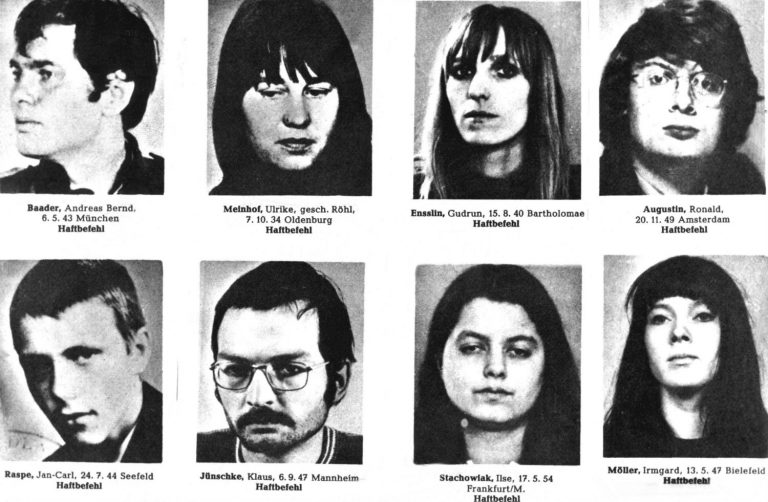
An extreme left-wing group active in the 1970s and 1980s. It officially ceased to exist in 1998. The group was also known as the Baader-Meinhof group, named after its founders Andreas Baader and Ulrike Meinhof.
After the Second World War, Germany lay in ruins. It was occupied and divided into four occupation zones between the United States, the United Kingdom, France and the Soviet Union. A few years later, in 1949, the Federal Republic of Germany was created by merging the three occupation zones of the Western Allies, while in the east the German Democratic Republic was formed from the Soviet occupation zone. The Federal Republic (West Germany) came under the Marshall Plan (one of whose aims was to curb the influence of communism), and the substantial aid it received helped turn a ruined country into the fastest-growing state in post-war Europe.
At that time almost the whole world was drawn into the Cold War, the trial of strength between the United States and the USSR. In the early 1960s, a wave of protests by secondary-school and university students swept most European countries. One of the reasons for the unrest in the Federal Republic was the large number of Nazi officials who, under American protection, remained in state service.
What pushed the students from peaceful protest to armed struggle was an event on 2 June 1967, during the visit of the Shah of Iran, Pahlavi, when 26-year-old student Benno Ohnesorg was killed. He was shot by police in West Berlin, although there was speculation that intelligence officers from the Shah’s entourage were also involved.
A year later, on 11 April 1968, Josef Bachmann attempted to assassinate one of the leaders of the student movement, Rudi Dutschke. He fired three shots at him but did not kill him.
These two events drove the founders of the RAF to more radical action. Andreas Baader and Gudrun Ensslin planted bombs in a department store in Frankfurt, causing major material damage. They were soon arrested and convicted.
Soon afterwards, a key member appeared who did a great deal for the organisation: journalist Ulrike Meinhof, who had for some time been writing articles sympathetic to the left. She asked the prison governor for permission to interview Baader. With the help of several comrades, she actually freed Baader and then became an active member of the terrorist group. This event, on 14 May 1970, is often cited as the founding date of the Red Army Faction.
After a well-planned escape, they fled to the Middle East, where they trained in PLO camps, learning mainly the basics of guerrilla warfare and bomb-making. On their return to Germany they began their operations. At first they mostly robbed banks – which is how they initially financed themselves – but also attacked state institutions, embassies, US military bases and the media. During bank robberies they used BMW cars, so for a while BMW was jokingly said to stand for “Baader Meinhof Wagen”, and the brand became an icon among criminals.
In May 1972, RAF members carried out six terrorist attacks across West Germany. Targets included the US Army corps in Frankfurt, the Federal Criminal Police Office in Munich and the building of the Springer media group in Hamburg.
There was great fear of the RAF, which had a number of women in its ranks. The police came under heavy pressure to find and arrest RAF members, and on 1 June officers arrested Baader and several comrades in a garage; a few days later Gudrun Ensslin and Ulrike Meinhof were also arrested. Virtually the entire first generation of the RAF ended up in prison.
A specially built wing of Stammheim prison was reserved for the RAF leaders. In the meantime a second generation had grown up. Siegfried Haag took over the leadership, and they set themselves the goal of freeing the first generation through assassinations and kidnappings. Many young people across the country approved of what the RAF was doing, and polls at the time showed that one in three young people would have given shelter to RAF members.
They continued their operations and were joined by other groups, the “2 June Movement” and the “Revolutionary Cells”. Their actions included attacks on police and banks. It was said that they were financed and armed by the East German secret police, the Stasi.
The second generation carried out an attack on the West German embassy in Stockholm, in which two hostages and two RAF members were killed. Germany set up special police units to fight such groups.
During the long trial of the first generation, on 9 May 1976, Ulrike Meinhof was found dead in her cell. She allegedly hanged herself, but how she did so was never explained. Years later it was said that the initial findings had shown signs of rape, and it was suspected that she had been murdered.
Her death enraged Baader and her ideological comrades. Baader demanded that his RAF comrades do something concrete, and in the period that followed they carried out a number of operations that resulted in the deaths of important people. On 30 July 1977 the head of Dresdner Bank was killed. In September of the same year, former SS officer and one of the most powerful industrialists in West Germany, Hanns Martin Schleyer, was kidnapped. The authorities were asked to release RAF members and two Palestinians from prison and to pay 15 million dollars. The authorities set up a crisis team headed by Chancellor Helmut Schmidt. The plan was to drag out the negotiations.
As nothing happened for a month, PLO members hijacked Lufthansa Flight 181 with the same demands as the RAF. The plane was first meant to land in Italy, then Cyprus, but ended up in Mogadishu, where the pilot was killed. The next day a hostage rescue operation was carried out, led by the German counter-terrorism unit GSG 9, with the participation of the SAS. The operation was code-named Feuerzauber (“Fire Magic”). The terrorists were killed and the hostages rescued.
On the same night as the Mogadishu operation, something happened in Germany that has never been explained. Andreas Baader, Gudrun Ensslin and Jan-Carl Raspe were found dead in their cells. The official version is that Baader and Raspe shot themselves with a pistol that someone had smuggled in, while Ensslin hanged herself. The only survivor, Irmgard Möller, who had allegedly stabbed herself in the chest four times, claimed that the state was behind the killings. The next day RAF members told journalists that they had killed Schleyer.
In 1977 the second generation of the RAF ceased to exist. It was followed by a third, fourth and fifth generation, which carried out similar but increasingly fewer activities, partly due to police work and partly due to global political changes.
Their last major operation was in 1993, when they planted a bomb and destroyed part of the women’s prison in Weiterstadt. Five years later, in 1998, they informed the Reuters news agency that they had disbanded.
Verena Becker was the last RAF member to be arrested, for her involvement in three murders during her time in the group. One of them was the murder of German Federal Prosecutor Buback, his driver and his bodyguard.
There are documents stating that four RAF members were arrested in Belgrade in 1978. Allegedly there were no grounds for their extradition, so they were released. The decision was signed by Stane Dolanc, then Yugoslavia’s chief security official. It was said that he was trying to exchange them for certain political fugitives in Germany.
Stevan Đokić